
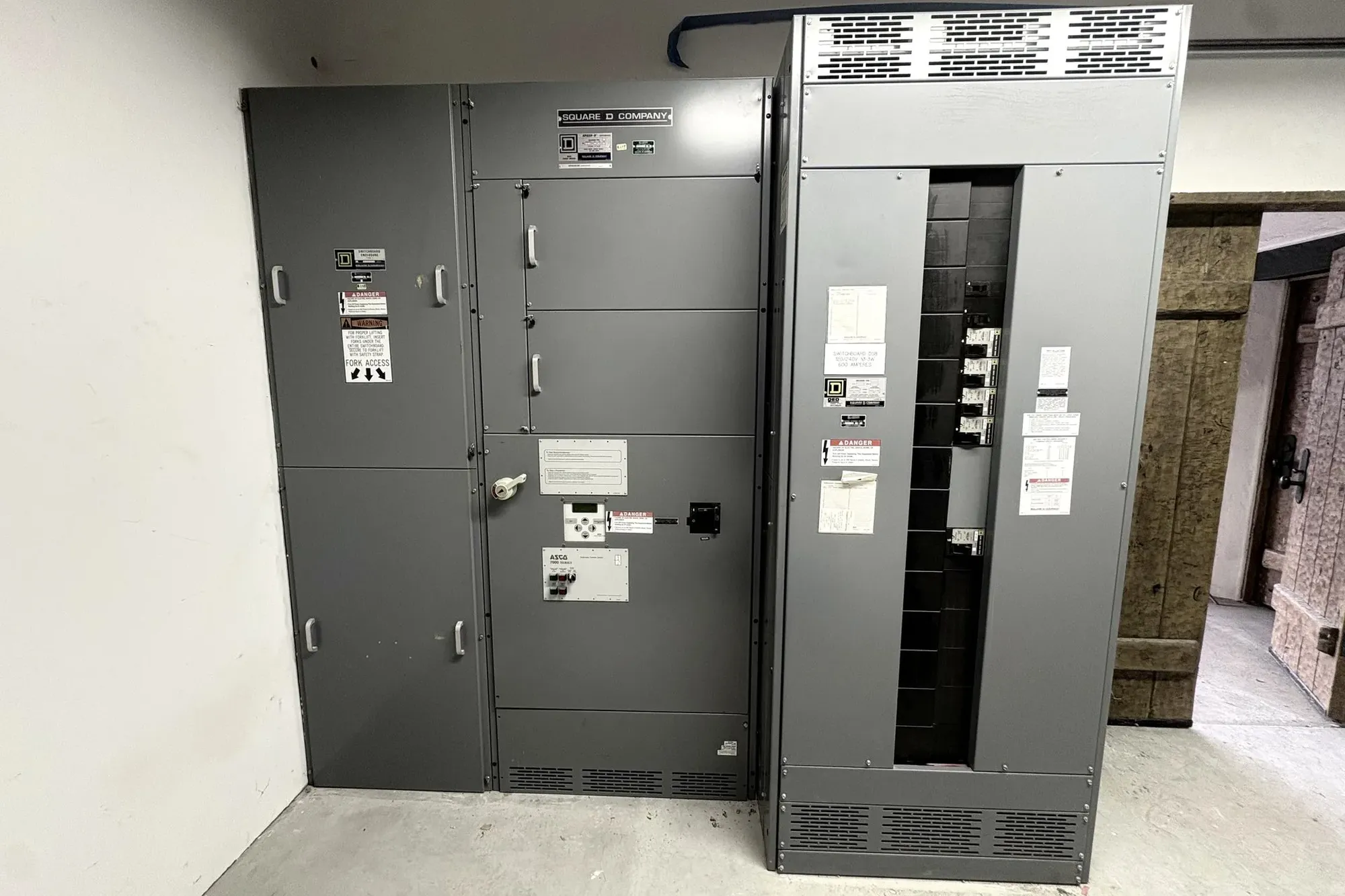
Electrical failures at a business rarely wait for business hours. The walk-in cooler trips on a Friday night. A tenant calls the property manager at 11pm because half the suite is dark. A three-phase compressor starts humming and won't come up to speed. This post covers what a San Jose business owner or property manager should do in the first half hour, what to tell the electrician when you call, and how to make the next after-hours call less likely.
Is it PG&E or the building?
Start with the utility. Look up the address on PG&E's outage map or call PG&E's outage line at 1-800-743-5002, then look outside. If the street lights, the business next door and the traffic signals are all dark, it is a utility outage and an electrician can't restore it. Your job at that point is protecting equipment for the moment power comes back, which is covered further down.
If the neighbors have power and you don't, the fault sits somewhere between the meter and your equipment: a main breaker, a damaged meter base, a failed service conductor or a feeder. That is an electrician's call. Buildings in Santa Clara run on Silicon Valley Power, so check with SVP there before anything else.
Half the lights work: the lost-phase problem
Most commercial buildings in San Jose run on three-phase service at 208V or 480V. When one of the three phases drops, from a blown utility fuse, a burned connection at the service or a failed breaker pole, the building goes strange. Some lights work and others don't. A row of outlets is dead. The rooftop units won't start.
The real danger is to motors. A three-phase motor that loses a phase while running will often keep turning on the two that remain, and those two windings carry the whole load. Current climbs and the windings overheat. A stopped motor usually refuses to start and sits there humming, which cooks it faster. If you see a partial outage in a building with compressors, pumps, CNC machines or rooftop HVAC, shut that equipment off at its disconnect until an electrician confirms all three phases are back.
The bill for a lost phase tends to arrive weeks later as a burned motor. Our three-phase motor repair vs replacement guide covers how that decision gets made. A phase-loss relay trips a motor automatically when a phase drops, and it is worth asking about on any motor your operation can't run without.
Exit lights and alarm panels run on a battery clock
When normal power fails, emergency lights and exit signs switch to battery. NFPA 101 requires that emergency illumination last at least 90 minutes, and the annual test exists to prove the batteries still can. Past that window the egress path goes dark, so if staff or customers are inside after dark and the outage drags on, plan to clear the building before the batteries run down. If your fixtures haven't been tested in a while, our emergency lighting testing guide explains the monthly and annual tests.
Fire alarm control panels carry standby batteries too. If the panel shows a trouble signal during the outage, call your alarm monitoring company. That is a separate call from the electrician.
Cold storage, servers and equipment that restarts badly
FDA guidance says a closed refrigerator keeps food cold for about four hours, and a full freezer holds temperature for about 48 hours (24 if it is half full). A walk-in follows the same physics, and every door opening costs time. Keep the doors shut, write down when the power went out, and put a thermometer where you can read it without opening the box. Restaurants and other food facilities also answer to county environmental health rules on what has to be thrown out, so check those before reopening.
For server closets and network gear, a UPS buys minutes. Use them to shut down cleanly.
When power returns, bring the building back in steps. Leave large motors, compressors and HVAC off until the service has been checked, then start them one at a time. Switching everything on at once after a fault is a common way to trip a second breaker.
What to tell the dispatcher
The first few minutes of the call decide whether the right truck shows up with the right parts. Have these ready:
- The address, the suite number, and who will meet the electrician with keys, gate codes or alarm codes
- What is dead and what still works: the whole building, one panel, some circuits or a single machine
- Anything you can smell, hear or see, such as burning plastic, buzzing, a scorched breaker or water near electrical gear
- The service voltage if you know it (208V or 480V) and where the main switchgear is
- Where the panel schedule or single-line drawing is kept
- Which loads matter most: refrigeration, a production line, a server room
If something is smoking or sparking, shut off the main if you can reach it safely, step back and call. Do not open panel covers. Our guide to what counts as an electrical emergency lists the situations that justify a 2am call, and the step-by-step emergency guide walks through the first minutes in more detail.
What happens when the truck arrives
The electrician traces the fault and isolates it first. Repairs happen on the spot where the parts are on hand. When something has to be ordered, such as a large breaker, a switchgear component or a utility-side part, the goal becomes making the building safe and restoring as much as possible with a temporary measure, then scheduling the permanent fix.
You should leave the visit with photos and a short written summary of what failed and what comes next. If the problem turns out to be on the utility side of the meter, we coordinate with PG&E, since their crew has to finish their part before the building can be re-energized.
After-hours rates and commercial accounts
After-hours work costs more than a daytime appointment, and you should hear the premium before anyone drives over. For a new commercial customer, Monte Power & Electric quotes the after-hours dispatch before the truck moves. Businesses and property managers on Net 30 or Net 60 accounts carry the after-hours premium inside their standing terms, which saves an approval scramble at midnight.
The Net 30 vs Net 60 guide explains how those accounts get set up, and property managers can put a whole portfolio under one property management retainer with priority dispatch. For pricing on a specific building, call 408-630-0548 or fill out the quote form.
Some after-hours work is planned
Plenty of night work is scheduled weeks ahead. Panel replacements, service upgrades and tenant improvement tie-ins often run at night or on weekends so the business can keep operating during the day. If your operation can't take a daytime shutdown, say so at the site walk so the schedule and the quote reflect it. Our commercial electrical services page lists the kinds of projects that usually get phased this way.
Making the next call less likely
Most after-hours failures give warnings first: a breaker that trips at peak load, a panel cover that feels warm, a burning smell that comes and goes. Three habits cut the odds.
Thermal scans. An infrared scan finds hot connections before they fail. The 2023 edition of NFPA 70B turned electrical maintenance from a recommended practice into a standard, and it sets a 12-month interval for thermographic inspection of most equipment. Ask whoever maintains your gear when it was last scanned.
A load check. Breakers that trip during busy hours are often a sign the building has outgrown its service. A commercial load study measures what the building actually draws before anyone sizes an upgrade.
Backup power. For refrigeration, production or life-safety loads that can't go down, a standby generator with an automatic transfer switch carries the building through a utility outage. PSPS shutoffs during fire season keep this on the agenda for Bay Area businesses, and the commercial standby generator guide covers permits and sizing.
Frequently asked questions
Do you handle commercial electrical emergencies after hours?
Yes. Monte Power & Electric runs a 24/7 emergency line for residential and commercial customers across San Jose and the Bay Area. Restaurants, retail, property managers and manufacturing customers are a regular part of the after-hours calls.How do I know if an outage is PG&E's problem or my building's?
Check PG&E's outage map for the address or call PG&E's outage line at 1-800-743-5002. If the neighbors have power and you don't, or only part of your building is dark, the fault is most likely on your side of the meter and needs an electrician.Why is only part of my building without power?
On three-phase service, losing one of the three phases leaves some circuits dead and others working. Shut off three-phase motors such as compressors, pumps and rooftop units until an electrician confirms all three phases are restored, because a motor running on two phases overheats.What does after-hours commercial electrical service cost?
It depends on the time, the fault and the parts involved. After-hours dispatch carries a premium that is quoted before the truck moves, and commercial accounts on Net 30 or Net 60 terms carry it inside their standing terms. Call 408-630-0548 or fill out the quote form for a quote on your building.Should I restart equipment as soon as the power comes back?
Bring it back in steps. Leave large motors, compressors and HVAC off until the service has been checked, then start them one at a time. Switching everything on at once after a fault is a common way to trip a second breaker.
Running a business that can't afford a dark night?
Set up a commercial account before you need it, and keep the number taped next to the panel schedule. Get an estimate or call the dispatcher to talk through the building. If the power is out right now, our 24/7 emergency electrician line is the faster route.
