Most owners who call us about a commercial standby generator have already picked the kilowatt rating. That is the easy part. The part that decides whether the project lands on schedule is a sequence of three separate City reviews plus one clearance from an agency that has nothing to do with electricity. Here is how a permanently mounted standby generator install actually runs in San Jose, in the order it happens.
The Air District clearance comes first
This is the step that costs projects a month. Before San Jose will issue a building permit for a permanently mounted standby generator, you need a job number from the Bay Area Air District. You can prepare and submit the building permit application while that number is pending. The permit itself will not be issued without it.
Get that clearance moving on day one, before the electrical drawings are even finished, because it runs on its own clock and nothing downstream can start without it. One wrinkle worth knowing when you call: at the Air District the instrument for a stationary engine is an Authority to Construct or a Permit to Operate, and the City's own Backup/Standby Generator Facility Permit Application asks for a copy of that permit or a statement of exemption. Ask for engine permitting specifically. The public information line is 415-749-4900; Engineering Services, on 415-749-4990, is the group that handles engines.
Nobody in the room notices the missing job number until the plans are approved, the fees are paid, and the permit still will not print.
If the set is diesel and it is a stationary emergency standby engine, an operating cap comes with it. Maintenance and testing is limited to 50 hours per engine per calendar year. That limit originates in the state Airborne Toxic Control Measure for stationary diesel engines, is separately codified in Air District Regulation 9-8, and then lands as an enforceable condition on your permit, which can be set lower than 50 hours for health-risk reasons. Read your own permit rather than assuming the 50-hour figure. Runtime to mitigate a genuine emergency sits outside the cap. Worth knowing that "emergency" is defined rather than self-declared, and a scheduled Public Safety Power Shutoff announced days ahead is a grey area, so log those hours carefully. The federal NESHAP allowance of 100 hours does not buy California operators more runtime, because the state measure is stricter.
Classify the system before you draw anything
The single line drawing changes depending on what the generator is legally for, so this decision comes before the design.
Article 700, emergency systems. Life safety loads. Power has to be restored within 10 seconds, and the emergency wiring has to be kept independent of all other wiring and equipment. The code lists specific exceptions, including transfer equipment enclosures, listed load control relays, unit equipment junction boxes, elevator traveling cables, and separated sections of switchgear where one source feeds both emergency and non-emergency loads with selective coordination. Two emergency circuits from the same source may also share a raceway. This is still the most expensive version of the same generator, because the separation requirements ripple through the whole building.
Article 701, legally required standby. Loads a code or an authority requires but that are not life safety. Automatic transfer is still required and the window widens to 60 seconds.
Article 702, optional standby. Installed because an outage costs the business money. A machine shop protecting a production run, a lab protecting sample integrity, a property manager protecting elevators and a leasing office. No code-mandated transfer time, and considerably more design freedom.
San Jose's electrical plan requirements make you state this on the drawings directly: a notation on whether the use is a code-required emergency system or a standby system for power outages. Getting that wrong on the sheet is a correction cycle. Getting it wrong in the design is a rebuild.
The three City reviews
A permanently mounted standby generator routes through Planning, the Bureau of Fire Prevention, and Building. All three have to clear.
Planning. Reviews the plans and decides whether the project qualifies for an administrative permit. If it does, there is a Backup/Standby Generator Facility Permit Application to complete. Historic Resources Inventory properties add a separate clearance.
Fire Prevention. Wants the generator and tank specifications, fuel type, listing number and listing agency, a HazMat inventory on the Building Occupancy Classification Inventory form, the fill and return piping plan, and the tank specification to UL 142 or UL 2085. It also wants runtime calculations for emergency and standby at 100 percent load against the minimum durations in Chapter 12 of the Fire Code. Fuel volume pulls in a second tier of requirements, and the thresholds differ: San Jose Fire's hazardous materials permit and Business Plan trigger at 55 gallons, while the operational permit for storage outside a building triggers above 60 gallons. Either way you are into double containment piping, overfill prevention and monitoring, emergency venting calculations, and a fuel tank vent terminating at least 12 feet above adjacent ground level. That 12-foot figure is the tank vent rather than the engine exhaust, which the City's own wording can make ambiguous.
Building. Electrical plans need the single line drawing, the panel schedule, the automatic transfer switch, the amount of load being picked up, and the grounding. Structural wants the foundation and pad, attachment details with calculations, and the anchorage on the floor plan. Mechanical wants ventilation including its backup power, the point of exhaust discharge, and make-up air.
The site plan carries one item owners rarely expect: noise level in decibels at the nearest property line, alongside setbacks, neighboring structures with use and square footage, and separation from buildings and public right of way. On a tight industrial parcel in Alviso or a mixed-use block downtown, that decibel figure can move the equipment pad or force a different enclosure.
Submittal runs through the Standard Plan Review Service. Apply at SJPermits, upload through SJePlans, answer plan review comments, pay final fees, then the permit issues.
Sizing, and why the nameplate is the wrong starting point
Owners tend to start from building square footage or from what the neighbor installed. Neither predicts the number. What sets it is the load list.
Three things drive a commercial sizing exercise:
- Motor starting inrush. A 40 HP chiller compressor or a large air handler pulls several times its running current for a few seconds. If the set is sized to running load, the lights dim and the breaker trips on transfer. Soft starters and VFDs change this math substantially, which is worth pricing against a larger set.
- What actually has to stay up. Most buildings do not need the whole service backed up. Backing up an emergency panel, an elevator, refrigeration, and a server room is a much smaller machine than backing up the building.
- The minimum load floor. Oversized diesel sets that never see real load wet-stack and carbon up. For the NFPA 110 monthly exercise to count, a diesel set has to reach either the manufacturer's minimum exhaust gas temperature or 30 percent of nameplate kW. A set that is too big for its own building becomes a maintenance problem, so oversizing has a real cost.
Three-phase service brings its own questions about switchgear capacity and where the transfer switch lands relative to existing distribution. If the existing gear will not accept the tie, the generator project quietly becomes a service upgrade project. We cover the checks for that separately in the commercial panel upgrade checklist, and the equipment side lives on the three-phase service page.
Testing, and the schedule that starts the day it commissions
A generator that has never run under load is an assumption. Under NFPA 110, systems get exercised monthly for a minimum of 30 continuous minutes, either at the manufacturer's minimum exhaust gas temperature or at no less than 30 percent of rated nameplate kW. Diesel sets that cannot reach that load in normal service need a supplemental load bank test annually, 50 percent of nameplate for 30 minutes then 75 percent for an hour. Level 1 systems, the ones whose failure could cause death or serious injury, add a test at least once every 36 months, run for the duration of the system's assigned class up to four continuous hours, again at no less than 30 percent of nameplate. The 30 percent load floor is a diesel rule; spark-ignited sets running on natural gas have no equivalent minimum.
Two conditions have to hold at once here, and that is the part to plan for. NFPA 110 sets a testing floor. The Air District permit sets a 50-hour annual ceiling on testing hours. Twelve monthly 30-minute exercises land at 6 hours, so there is normally plenty of headroom, though a load bank day plus a triennial run plus a real outage eats into it faster than owners expect. Log the hours.
Buildings on an ongoing account get the exercise, the load bank, and the annual inspection folded into one calendar alongside the panel and lighting work. That is most of the reason a property management electrical retainer pays for itself: the same crew that installed the transfer switch is the crew logging the tests, and the records exist when the inspector asks. The wider maintenance schedule is in the multi-unit electrical maintenance post.
Generator, UPS, or both
These solve different problems and get confused constantly.
A generator handles duration. Fuel on site means hours or days of runtime, which is what a PG&E transmission fault or a Public Safety Power Shutoff actually calls for. It does not handle the gap: even a fast Article 700 transfer leaves several seconds of darkness.
A UPS handles that gap with no transfer delay at all, then hands off to the generator or shuts equipment down cleanly. Runtime is minutes. For a server rack, a lab instrument mid-run, or a CNC control that loses its work coordinates on a dropout, those minutes are the entire point. UPS work on machine tools sits alongside the rest of the machine shop electrical scope.
Facilities with both problems install both, sized for their own job: the UPS for ride-through, the generator for endurance. On the residential and small-commercial side the trade-off runs differently, and the battery versus standby generator comparison walks through it.
A realistic timeline
Permitting dominates the schedule. The Air District job number, three parallel City reviews, and at least one correction cycle set the pace long before anyone pours a pad. Equipment lead time on larger sets and on transfer switches can run longer than the permit.
The installation itself is short by comparison: pad and anchorage, conduit and feeders, the transfer switch, ventilation and exhaust, then commissioning with a load test and the first documented exercise. Ask for the outage window in writing early, because tying a transfer switch into live gear in an occupied building means either a planned shutdown or after-hours work.
What to have ready before you call
The quote gets tighter and faster with these in hand:
- A load list, or at least the list of equipment that has to stay running
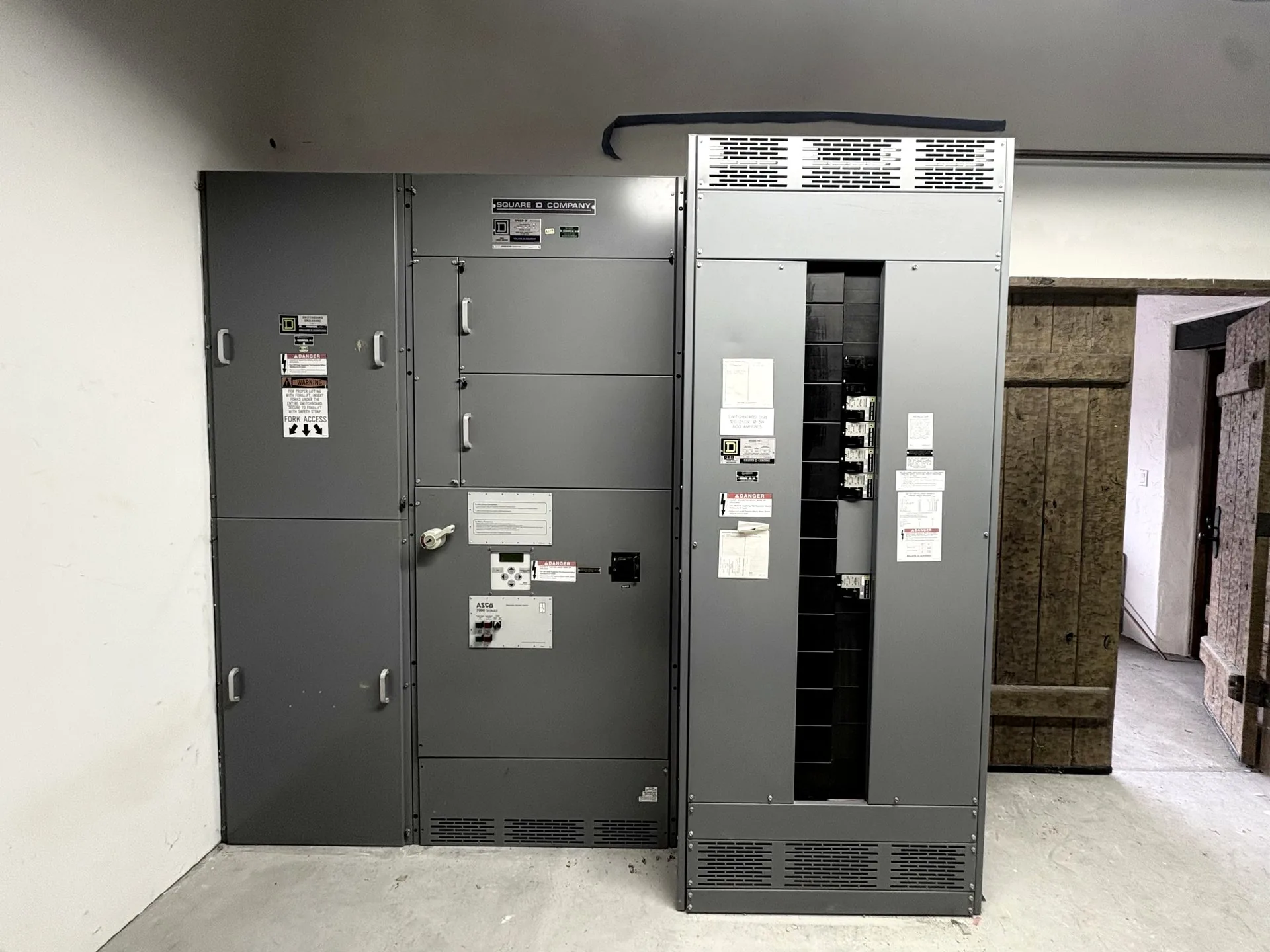
- Photos of the main service, the switchgear, and the panel schedules
- Service size and whether it is single or three-phase
- Whether any of the backed-up load is code-required life safety
- Where the pad can go, and the distance to the nearest property line
- Fuel preference, and whether natural gas is available at the site
- Any tenant or lease restriction on noise or after-hours work
Monte Power & Electric is a licensed C-10 contractor, CSLB #1156675, carrying $2M in general liability on every job, working across San Jose, Santa Clara, Mountain View, Milpitas, Los Gatos, Morgan Hill, and the wider Bay Area including San Francisco, Oakland, and Palo Alto. Cost depends on the load list, the classification, the fuel, and how much of the existing gear can be reused, so there is no useful number to quote from a blog post. Call 408-630-0548 or fill out the quote form at our contact page and we will walk the site. If the power goes down before the generator is in, emergency dispatch runs 24/7.
Frequently asked questions
Do I need an air permit for a standby generator in San Jose?
You need a job number from the Bay Area Air District before the City of San Jose will issue the building permit. You can prepare and submit the building permit application while the job number is pending, but the permit will not be issued without it. The Air District can be reached at 415-749-4900.How fast does a generator have to pick up the load?
It depends on how the system is classified. Under NEC Article 700 an emergency system has to restore power within 10 seconds and needs wiring kept independent of everything else. Under Article 701 a legally required standby system has 60 seconds. Under Article 702 an optional standby system, installed to protect production or revenue rather than life safety, has no code-set transfer time.How often does a commercial generator have to be tested?
For systems under NFPA 110, exercise the set monthly for at least 30 continuous minutes, either at the manufacturer's minimum exhaust gas temperature or at no less than 30 percent of nameplate kW. The 30 percent floor applies to diesel; spark-ignited sets have no load minimum. Diesel sets that cannot reach that load in service need a supplemental annual load bank test. Level 1 systems also get a test every 36 months, run for the duration of the system's assigned class up to four continuous hours.How many hours a year can I run a diesel standby generator?
Maintenance and testing on a stationary emergency standby diesel engine is capped at 50 hours per engine per calendar year. The limit comes from the state Airborne Toxic Control Measure, is codified in Air District Regulation 9-8, and appears as a condition on your permit, which can be set lower. Runtime to mitigate a genuine emergency is separate from the cap. Read the permit rather than assuming 50 hours, and log the hours.Which reviews does a San Jose standby generator permit go through?
Three: Planning, the Bureau of Fire Prevention, and Building. Planning decides whether the project needs an administrative permit. Fire reviews the fuel tank, the HazMat inventory, separations, and the runtime calculations at 100 percent load. Building reviews the single line drawing, panel schedule, transfer switch, load, grounding, anchorage, and ventilation.Is a generator or a battery the right backup for a commercial building?
A generator runs as long as it has fuel, which is what a multi-day outage needs. A UPS or battery covers the seconds-to-minutes gap with no transfer delay, which is what servers, lab instruments, and CNC controls need. Buildings with both a long-outage problem and a ride-through problem end up with both, sized for different jobs.
Planning a standby generator for a commercial building?
Send the load list and photos of the service and we will size the set, classify the system, and map the permit path. See our generator installation service or call 408-630-0548 to talk through the scope.
